Jules: October 6 follow-up review
By Julius Lupowitz
These revisions are on staging for review. The live website, YouTube, Blogger and social profiles have not received this October 6 round.
Full written copies
- Dryer Vent Maintenance — Look Beyond the Appliance
- Inside the Ductwork — Mold and Airborne Contamination Explained
- Choosing a Coach — Look Beyond the Certificate
- Monsanto's Roundup vs Sizzle — A decision Julius E. Lupowitz made over 30 years ago
Dryer: full original narration plus October 4 addendum
Open dryer video full screen · Watch on YouTube
The full original narration and October 4 addendum are retained. FINISHED, STRAIGHTENED DRYER EXHAUST is now overlaid on the completion photograph as requested. The unaltered source photograph is retained in the project archive.
Square duct: corrected project sequence
Open ductwork video full screen · Watch on YouTube
The duct review includes my October 6 narration, arranged by section, with the supplied before-and-after photographs at the end.
Supplied duct photographs: before and after
Jules identified these October 6 supplied photographs as the same HVAC cleaning job.


Loopy Lids: business history, 1989–1994
Open Loopy Lids history review
The October 7 review includes the three new hat photographs, Groovy Hip-Hop by Kulakovka, and approximately 33% shorter image timing.
October 7 hat photographs
Loopy Jester. Jules reported that the remaining Polar Visor with goggles is missing.


Business history supplied by Jules
BUSINESS history for Loopy Lids: as discussed div of a company, -Green Way the Clean Way, Incorporated.
-1989-1994
-JL was president of Green Way, above. -Directed Staff of 16 reps via Tele sales to reach any and All boutique, ski shops, sports apparel stores, sporting goods near ski Mountains in United States & Canada.
-JL personally traveled nationally snowboarding, Via major ski/snowboard resorts as well, with appointments and/or personally visiting retail stores, and similar businesses selling apparel and equipment as such. JL brought with him samples of Polar Copters (capitalize, all hat models) for adult adults, or children sizes, sidewinders with propellers on the side, mummies, polar visors which included goggles and replacement lenses, loopy jester hats, the whatever hat, pill box, baby bonnets for adults and children. Some of these models are on the loopy lids section under the Chalnick family website
That minimal webpage built by Andrew Chalnick (Vice-Chair of the Burlington City Council-Vermont, former Tax Planning Director at JPMorganChase) in his spare time… That was a relatively quick build at a time when websites were relatively new. The line of loopy lids has ceased due to the goofy hat craze trend ending although Jules believes it could be reinvigorated and brought back. Although the polar copter was under the name of the proper not at the beginning, because it was made with authentic 200 series polar tech material from Malden Mills, the name was changed to polar copter. Making kids sizes for everything was very productive along with the invention of the mummy, which replaced headbands or neck bands with a hat, which could perform as either for less money because it was made with the Waste polar tech material when creating the polar copters.
This trend of the goofy hat craze started essentially by the jester hat company was capitalized on by Jules at a time when it was very popular. Upon its end, he realized he didn’t know anything about the common industry or trends at all. And that gave way to him increasing promotion and production on the mummy, which was a fully functional hat and very logical. This also gave way to the polar visor, which provided very warm earmuffs, along with a sunvisor and Strong Velcro fastener to hold it on a skier or snowboarder’s head when moving at quick speeds. Goggles which were made out of Lexan clear plastic were replaceable and much less money overall than any set of goggles.
New business-history source photos: Hammerhead
The two shirt/logo photographs supplied October 5 are preserved here for review. Please provide the associated company, approximate years and your role so the history can use your facts.


Supplied text returned for review
Dryer Vent Maintenance — Look Beyond the Appliance
By Julius Lupowitz
Dryer repair: the complete rebuilt exhaust route
Open video full screen · Watch on YouTube
DRYER OPERATED PERFECTLY ONCE EXHAUST SYSTEM WAS STRAIGHTENED. AND UNCLOGGED OF EXCESS LINT
The review video now includes both my original recording and my October 4 addendum in full, with the supplied completion image held through the narration. The wider original image has not yet been located.
A dryer can look fine from the outside while its exhaust route still needs attention. My archive includes footage from before a vent repair and a photograph of the completed work. I managed the crew on that project. The useful lesson is to look at the whole exhaust path, not just the appliance standing in front of you.
I recall this project in a high-end New York City apartment building, with ductwork running through wooden closet spaces. In apartment laundry spaces, the route can be easy to overlook. A connection behind a machine, a tight bend, or a damaged section may be difficult to inspect without moving equipment. An expensive appliance or attractive enclosure does not tell us whether the exhaust path is working as intended.
For this project, I identify the video as the condition before repair and the photograph as the rebuilt route after a kinked section was addressed. Showing both helps explain what the crew was trying to improve.
The U.S. Fire Administration advises cleaning the lint filter and checking the venting system for damage, crushing, or restrictions. These are practical maintenance concerns. Restricted airflow and lint accumulation are fire risks, but it would be inaccurate to claim they cause every dryer fire or that a duct system can never be involved in a fire.
Follow the appliance manufacturer's installation and maintenance instructions. If the exhaust route is damaged, blocked, or performing poorly, arrange a suitable inspection rather than assuming a new dryer will solve the underlying problem. Good project management means understanding the whole system and documenting the work clearly.
Another dryer project: cleaning and the exterior exhaust
Open video full screen · Watch on YouTube
In this separate narrated sequence, I show brush-and-blower work, removed debris, and the route to a Brooklyn roof. The original recordings are dated September 30, 2021. The roof inspection identifies the need for more brushing; the sequence then shows the brush work and collected debris. This clip documents work in progress and should not be described as a certified finished repair.

Reference: https://www.usfa.fema.gov/downloads/pdf/publications/clothes_dryer_fire_safety_flyer.pdf
Inside the Ductwork — Mold and Airborne Contamination Explained
By Julius Lupowitz
This article is about the air you breathe where you live or reside.
People usually see the room-side grille or filter, not the interior of their ductwork. Photographs and footage from crews I’ve managed show another part of that picture: conditions before cleaning and the work in progress. In my experience, systems left for two or more years can show discoloration, accumulated dust and pollen, other debris, and sometimes insects or animal remains. The condition of a particular system needs to be inspected rather than assumed from its age.
Specialized skills and equipment are used to remove this debris. In the supplied footage, I describe a high-pressure air hose with automated circular brushing to loosen debris while a vacuum collection system captures it.
Ductwork: visual archive
Open ductwork video full screen · Watch on YouTube
The duct sequence uses my October 6 narration, arranged in sections at the major pauses. It ends with the before-and-after photographs I supplied from the same job. The after image is labeled in large bold red text: AFTER, Duct fully cleaned.
Split AC: before, cleaning and after — November 14, 2021
Open video full screen · Watch on YouTube
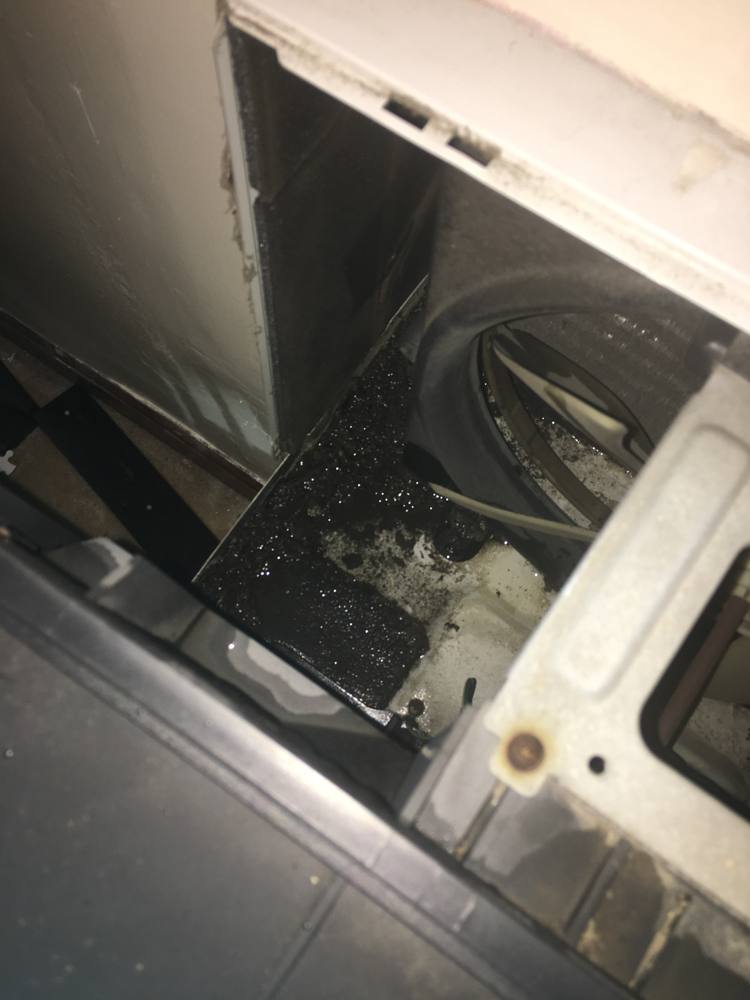
In these additional split-system recordings, I describe what I saw and show the cover removed, protective sheeting, collection of runoff, cleaning in progress, and the finished unit. These are historical examples from my project archive, not instructions for cleaning live electrical equipment. My spoken references to mold describe my observations; the footage alone cannot identify the material or confirm a laboratory result.
What I observed inside these systems
Dark spots along the fins and buildup inside the air pathways are the conditions I want people to notice. Based on my experience managing cleaning crews, I describe suspected mold and other contamination in these examples. Mold, bacteria, algae, dust and other contaminants may occur where moisture and debris accumulate. A photograph alone cannot identify which organisms are present; inspection and, where needed, testing establish that.
AC MOLD REMOVAL, DEBRIS REMOVAL AND MOISTURE CONTROL DESERVE ATTENTION — ESPECIALLY WHERE PEOPLE ARE SENSITIVE TO AIRBORNE CONTAMINANTS.
Window and large wall AC examples
The window-unit photographs are identified by me as July 26, 2021. The original camera metadata identifies the large wall AC group as October 15, 2021, and the split AC group as November 14, 2021.


My supplied wording — review copy
A room-side filter does not show mold, bacteria, or microscopic airborne particles. Filtration can reduce large, dust-like objects but not mold or airborne contaminants, which are actually microscopic. These get past all filters. AC mold removal or professional cleaning, eliminates, airborne particles, while moisture control, drainage, inspection and maintenance also matter.
With low priced AC units many times replacement can be a lower expense than actual mold removal or maintenance. These examples should confirm that every AC type collects mold and that filters are ineffective for otherwise unhealthy airborne contaminants.
Another truth is while professional mold removal, cleaning type services are not medical procedures, I have personally been thanked, not only by clients with breathing issues, such as allergies, asthma, or just due to age or lack of health. Medical professionals, such as doctors and veterinarians have noticed large positive differences in breathing condition, conditions, and quality of life of people and animals.
Choosing a Coach — Look Beyond the Certificate
By Julius Lupowitz
When someone asks me how to evaluate a coach, I start with the work the person needs help doing. A credential may tell you something about training. It does not, by itself, tell you whether a particular person understands your circumstances or will be useful to you.
Ask for relevant experience. What responsibilities has the coach actually held? What problems have they helped clients work through? Which references can you contact with permission? A polished biography should lead to information you can investigate, not replace it.
Then ask how the relationship will work. Who will provide the coaching? What will happen in the first conversation? What goals will you set together, and how will progress be reviewed? Clear expectations matter more than a sweeping promise that one method works for everyone.
Fees and scope should be understandable before you commit. Clarify what is included, whether additional services cost more, and what happens if the arrangement is not a good fit. Coaching should also have boundaries: when a concern calls for a licensed professional or another specialist, the response should respect that need.
My preference is for direct conversation, practical experience, accountability, and references people can follow up on. Readers should evaluate those qualities in me as carefully as they evaluate them in anyone else.
The coaching field includes different business models and levels of experience. I am not attaching an unsupported percentage to industry revenue or claiming every training program is a sham. The useful question is narrower: can this professional explain what they offer and provide relevant evidence that helps you decide?
Monsanto's Roundup vs Sizzle — A decision Julius E. Lupowitz made over 30 years ago
By Julius Lupowitz
SIZZLE — A Decision I Made More Than 30 Years Ago
At 19 years old, while still in college, I founded Farm Pro Industries Inc. and developed an EPA-registered herbicide called Sizzle, using diquat dibromide as its active ingredient.
Both diquat and glyphosate remain commercially used herbicidal ingredients today.
Sizzle was developed as an alternative to glyphosate-based Roundup. I knew then as now, I was not about to seriously compete with a giant powerhouse like Monsanto, now owned by Bayer Labs. But agriculture being the biggest USA industry then, with a crew of just 10 to 20 telemarketers I was able to target a tiny %. Maybe even make some positive noise. But when I became concerned about the potential hazards associated with diquat, I stopped production.
That decision was made decades ago. Well before the few mistakes of Jules during a tough time.
Roundup remains a major commercial herbicide brand, and glyphosate-based Roundup products remain used in agriculture. Monsanto, however, was acquired by Bayer in 2018; today’s corporate ownership and distribution structure is different.
I don’t claim Sizzle was harmless. It wasn’t. The point is simpler: That was it's goal. But when I discovered a potential problem with a product I was responsible for, and I chose to discontinue it.
That decision — to walk away from Sizzle — is part of my story.
All toxicity and cancer problems associated with Roundup, uncovered well after I discontinued Sizzle still exist. Over time I learned I could not control enough overbearing pollution that actually comes from agriculture itself. Therefore, Farm Pro Industries, Inc. was dissolved.
Environmentally safe chemical solutions in several other industries were developed by Greenway Industrial Products, Inc. with Green Way The Clean Way, Inc. 535 South Oyster Bay Rd., Hicksville, NY, which I also founded.
(Original label unavailable. Example label is below).


Remaining source questions
The Sizzle message stopped at “It’s one example of how I thought, h”. The HVAC message stopped at “As-Need”. These unfinished fragments have not been completed on your behalf.
For profile links, your website is https://juleslupowitz.com/ . The existing Google link opens your profile: https://share.google/PBlwop6OVScNq7Ph6 . A direct review-form link is still needed.